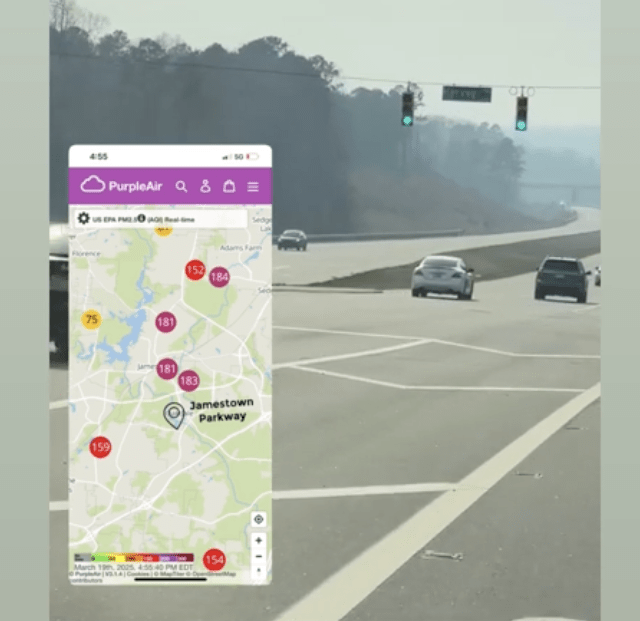
Coughing? Irritated eyes? Respiratory issues? Might be time to learn about tiny air pollutants called “particulate matter” – especially breathable “particulate matter 2.5” (better known as “PM2.5”) with a diameter of 2.5 micrometers or less – about 30 times thinner than a human hair.
A year and a half’s worth of data that was just downloaded from eight sensors shows PM2.5 matter in Jamestown 27282 is higher than the national average, and it’s trending upward.
ANNUAL READINGS – The annual reading for the 12 months just ended (4/17/25-4/16/26) shows average PM2.5 levels in Jamestown of 7.51 µg/m³, slightly higher than the U.S. annual average of 7.3 µg/m³ and significantly higher than the World Health Organization annual safety limit of 5 µg/m3.
The main sources of PM2.5 are diesel engines, industrial processes, and soot and smoke from wildfires and open burning. Particulate matter from leaf blowing and pollen are too big to be picked up by the sensors.
The annual levels of the Jamestown 27282 Community EPA air monitoring project have tracked upward since the project launched in November 2024, with average 12-month levels of 7.27 µg/m³ for 11/15/24-11/14/25; 7.36 µg/m³ for 1/1/25-12/31/25; 7.4 µg/m³ for 3/1/25-2/28/26; and 7.51 µg/m³ for 4/17/25-4/16/26.
DAILY READINGS – In 2021, the World Health Organization defined the maximum safe DAILY limit as 15 µg/m3, at a maximum occurrence of no more than FOUR days a year.
Jamestown had 32 days that exceeded 15 µg/m3 in the past year and a half. The highest numbers registered at the sensors on the Town‘s southern and northern borders: Riverdale Drive, near Eastside Wastewater Treatment Plant, Jamesford Meadows, and Penny Road near the Piedmont Environmental Center.
The worst 20 day averages for the eight sensors (two of which were placed in wooded areas with heavy tree canopies), are shown below:

Monthly PM2.5 averages for Jamestown 27282 are shown below, highest to lowest:

Data collection methods, device details and EPA conversion formulas will be shared in detail in the final report to EPA, and linked here once available.
The results of IQAir’s 8th annual World Air Quality Report (released last month) show that in the United States, annual average PM2.5 levels increased to 7.3 µg/m³.
Smoke from wildfires in both Canada and the U.S. raised averages across parts of the Great Lakes states in the summer and in the Pacific Northwest in the fall. Dust storms are blamed for placing El Paso at the top of the “most polluted U.S. cities” list with PM2.5 levels of 11.4 ug/m3. Seattle is the cleanest, with an annual average of 4.5 µg/m³.
In March 2025, the U.S. Department of State announced that it was ending the sharing of information from its DOSAir global air quality monitoring program. Since 2015, the program has provided real-time air pollution data from more than 80 embassies and consulates, filling critical monitoring gaps in regions where governments lacked their own means to track air pollution effectively. The data was instrumental in shaping air pollution awareness, influencing policy discussions, and enabling communities to take protective measures against hazardous air conditions.