On Jan. 7th & 8th, the NC Environmental Management Commission (EMC) will vote on new proposals for PFAS and 1,4 Dioxane regulation that would require “monitoring and minimization plans” for industrial polluters, but leaves out chemical discharge limits and automatic civil penalties for the polluting facilities. The meetings will be held at the Archdale Building in Raleigh, are open to the public and a livestream is available. The timing of this vote is significant due to the NC Assembly’s passage of REINS Act, H.B. 402 in August 2025. The act requires that any “regulation” that is expected to cost $20 million+ over five years to implement – must be approved by the NC General Assembly, regardless of its benefit to the citizens of North Carolina. If the EMC votes to approve the proposal, a mandatory 60-day public comment period follows – the last chance for North Carolina residents to influence the outcome.
—-
This December 10, 2025 letter from the Southern Environmental Law Center to the North Carolina Environmental Commission is a great history and overview of North Carolina’s PFAS and 1,4-Dioxane contamination. A few excerpts are below:
“In January, the EMC will be presented with a set of PFAS rules that are far removed from what the [NC Department of Environmental Quality] intended. This is no surprise because they were written by polluters, and intentionally crafted to ensure that neither industry nor wastewater plants have to do anything about their toxic chemical pollution. Not only that, but the Department and the public will be denied valuable information because the water quality committee bowed down to polluters that wanted to keep the public in the dark about dozens of PFAS chemicals being released into our state’s rivers and drinking water sources.”
“[Legal] Counsel for the NC Rules Review Commission* later thanked the lawyer for Reidsville for providing him with the justification he was looking for to stonewall the [1,4- Dioxane water quality standards] rule.” *The Rules Review Commission is the entity behind the reworking of the NC Environmental Management Commission so that the majority members now consist of anti-clean water, pro-chemical industry appointees.
“In March, 2024, shortly after the NC Department of Environmental Quality announced it would be adopting 1,4-dioxane numeric standards, the cities of Asheboro, Greensboro, and Reidsville (the three largest municipal sources of 1,4-dioxane in the state) sent a letter to the EMC urging it to delay the 1,4-Dioxane standards, and offering misleading information regarding the costs of complying with the standards. The three cities argued that in order to comply with the limits, they would have to install extraordinarily expensive treatment technology at the utility itself—entirely ignoring the fact that the wastewater plants [like Eastside Wastewater Treatment Plant] have the authority and obligation to make their industrial customers treat or eliminate 1,4-dioxane before it ever reaches the utility.“
“Like the PFAS rules that will be before the EMC in January, the 1,4-dioxane rules are written by the regulated [polluters] community. They represent a polluter wish-list, and they do not require industrial dischargers to take any steps to reduce their toxic chemical pollution. These rules are insulting to the NC Department of Environmental Quality, which has spent more than ten years tracking and identifying the sources of 1,4-dioxane across our state and has attempted to limit discharges through multiple means, including through discharge permits and special orders by consent. And they are insulting to the communities who have suffered from exposure to this pollution for decades.”
“North Carolinians deserve better. More than four million North Carolinians—nearly half the State’s population—drink water sourced from surface waters and rely on drinking water utilities for safe drinking water. More than one million of those people drink 1,4-dioxane-laden water, and at least 3.5 million drink water with unsafe levels of PFAS. Failing to require industries and wastewater plants to control their PFAS and 1,4-dioxane pollution has serious consequences for these communities and the drinking water utilities that serve them. As the former Department Secretary Elizabeth Biser said, without strong rules making industry pay to remove PFAS at the source, ‘the entire burden’ of removing industrial chemicals falls on public water system customers.”
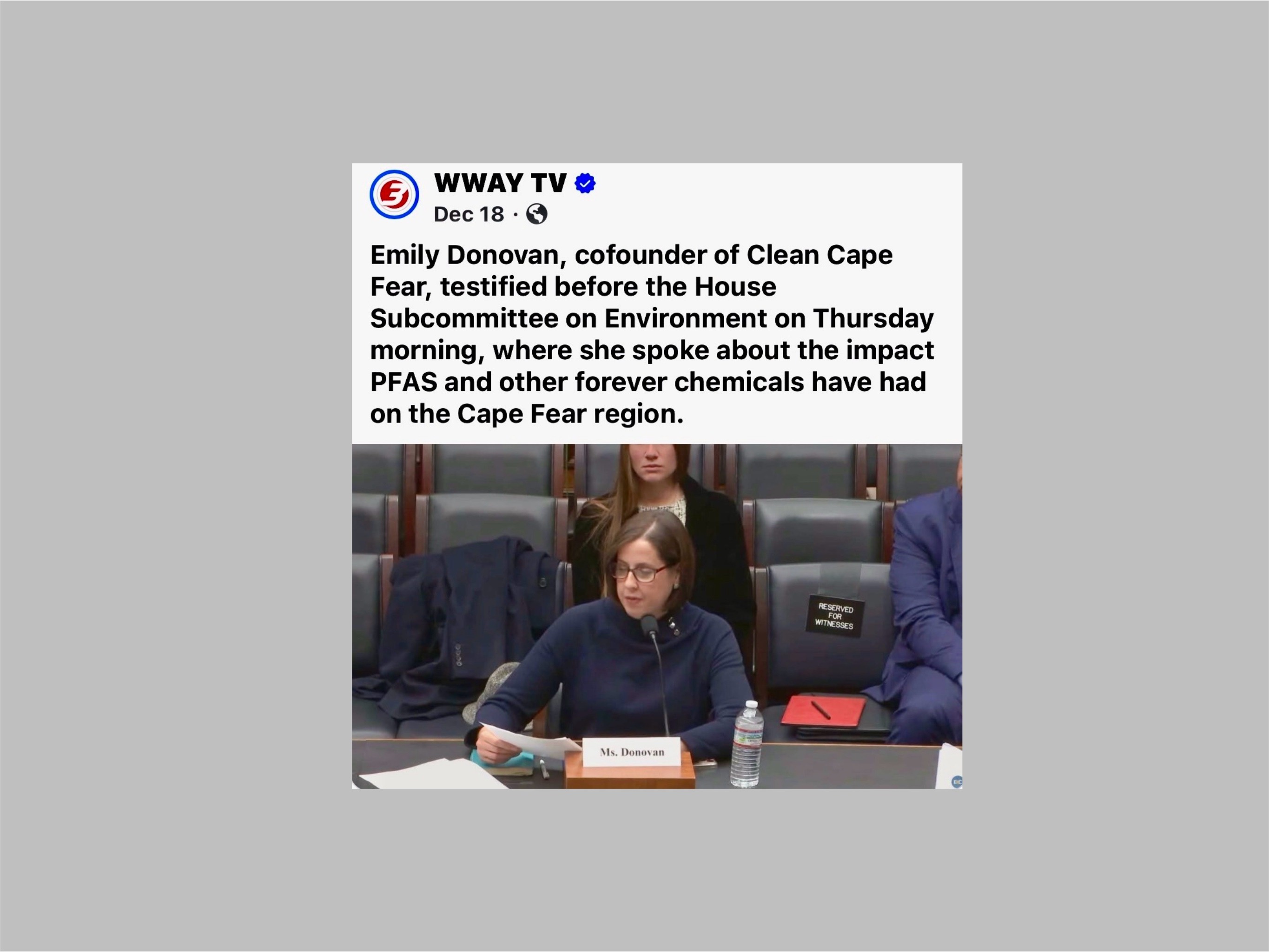
On December 18th, Emily Donovan (cofounder of Clean Cape Fear) testified before the U.S. House of Representatives in opposition to a bill that would weaken accountability at the federal level. Follow Clean Cape Fear on Facebook for updates:
