
UPDATE AUGUST 1, 2025: Another air complaint by local residents was reported in May (2025). Details are HERE.
UPDATE MAY 29, 2024 – There will be no Public Comments period for renewal of Alberdingk Boley’s 8-year AIR EMISSIONS PERMIT. The Air Quality Division of the NC Dept of Environmental Quality says that Alberdingk Boley, a German polyurethane and acrylics manufacturer located in the middle of residential and shopping areas on Gate City Blvd in Jamestown, is EXEMPT from Title V Clean Air Regulations.
Alberdingk Boley emits particulate matter, toxic emissions and hazardous air pollutants from horizontal pipes; is located 300 meters from a residential neighborhood in Adams Farm; is located 600 meters uphill from drinking water supply stream Bull Run; uses the SIC Code for “Food Warehousing” on its wastewater permits; has high levels of 1,4 Dioxane in its wastewater pretreatment samples; has generated numerous air emissions complaints of respiratory problems and eye irritation from local residents; increased its production with new equipment in the past year; and “self reports” its emissions of carbon monoxide, lead, mercury, glycol either, benzene, styrene, xylene, arsenic and nitrogen oxide.

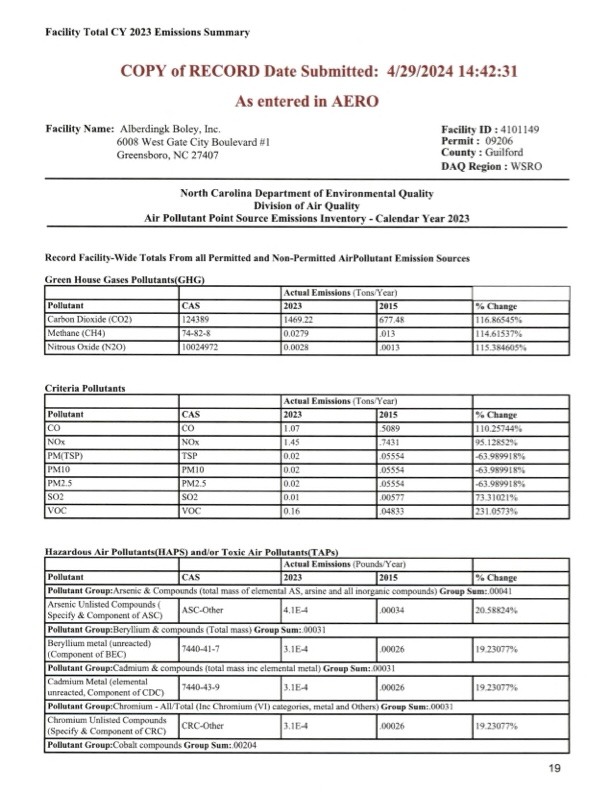
ORIGINAL POST May 24, 2024 – Alberdingk Boley has applied for an EIGHT-YEAR RENEWAL of its air emissions permit. Here’s a summary of what Alberdingk SELF-reported as their hazardous and pollutant air emissions for the year 2023 (click to zoom in):


Alberdingk Boley also has a lot of wastewater and “product” storage tanks on site – here’s the list:


The next group of images are three overhead satellite views, zooming in on the Alberdingk facility, tanks and wastewater “ponds” at 6008 W. Gate City Blvd – Bull Run is downhill from Alberdingk and flows north-south through the D.R. Horton property where it receives stormwater, spills and groundwater from Alberdingk Boley and the 80-acres of contaminated Brownfield soil on which Alberdingk Boley and Fortress Wood Products sit:”


The application states that emission vapors vent through 25-foot and 45-foot vertical pipes.

We’ll take a closer look at the contaminants, but first, let’s talk about the permitting and zoning practices that enable Alberdingk Boley (and other industrial dischargers) to bend the polluting rules:
- Spotty Zoning. According to the current (2023) Jamestown zoning map, Alberdingk Boley is located in Jamestown’s “Extra Territorial Jurisdiction,” because it is drawn within the orange ETJ boundary lines. Yet Alberdingk Boley’s address for permitting purposes is 6008 Gate City Blvd., Greensboro, NC instead of Jamestown, NC – which means the zoning line is drawn to capture enough inches of the front curb to put the legal address in Greensboro, even though the entire building, tanks, pipes and site are physically located in Jamestown 27282. Here’s how that looks – In the image on the right, below, Alberdingk’s property is the gray triangle. The orange zoning line, which according to the map legend is ETJ, is circled in red marker:


Last year, when we learned about their October 2022 spill of 16k gallons of wastewater into Bull Run, NCDEQ staff notes said folks from Jamestown and High Point were on the scene, but mentioned no one from Greensboro or Guilford County in attendance. No one from Alberdingk Boley, High Point or Jamestown alerted the public and surrounding neighborhoods about the spill, even though the town manager listed the event in his Stormwater Permit renewal application.
Alberdingk’s wastewater is sent to High Point Eastside Wastewater Plant, which outfalls to Deep River/Randleman Lake, Class WSIV-CA* drinking water supply. The NCDEQ staffers on the scene spoke with Eastside staff about what to do with all that contaminated water.
Alberdingk Boley got a small fine for not having the proper permit, and received NO violations for failing to inform Jamestown and the surrounding community about the 16,000 gallon spill of raw industrial wastewater into Bull Run, which flows through local backyards and neighborhoods before ending up in Deep River and Randleman Lake.
Alberdingk had another spill into Bull Run in November 2023. We submitted a Freedom of Information Act public information request to NCDEQ a couple of days after it happened asking for the details. We are still awaiting a response from the NCDEQ.
2) PERMIT DISCREPANCIES. Then there’s the matter of the glaring discrepancy between Alberdingk’s Air Quality Permit and Water Discharge (NPDES) Permit: The SIC code (“Standard Industrial Classification) on the Air Permit is for a plastics and resin manufacturer – which is what Alberdingk is.
The Water Discharge (NPDES) Permit, however, is for food warehousing – which Alberdingk Boley is not. Further, it’s a “general” permit, which means lax rules, and self-reported monitoring.
There are, in fact, several of these in Jamestown: stormwater permits that don’t match their business purpose, and “general” permits that should instead be granted under specific industry code classifications.
3) WATER SUPPLY STREAMS NOT PROPERLY CLASSIFIED. There’s also the problem of Bull Run stream’s misclassification in the U.S. Environmental Protection Agency records, where it is shown as an “aquatic source for fish” instead of a CLASS IV Critical Drinking Water Supply Stream, which is how the State of North Carolina classified Bull Run back in March of 1999.
The problem is the State of North Carolina hasn’t reported the proper classification to the EPA (it is the NCDEQ’s responsibility to do that) nor has it bothered to correct it, despite three years of requests from Jamestown residents.
The refusal of Jamestown’s town manager and town council to require the town’s Land Ordinance be updated with the 2020 Randleman Watershed Rules enabled D.R. Horton’s attorney to ignore the protections the new Rules provide to Randleman water supply streams like Bull Run, Deep River and their tributaries.
It also explains why companies like Alberdingk Boley, Univar, Teknor Apex, Highland Container/Hood Industries and Oakdale Cotton Mill hold “general” permits, and permits for things like “finished sewing apparel” instead of permits for what they actually do, like “container manufacturing” and “PVC compounding.”
That’s why we made a fuss about getting all this straight in the 2024 Impaired Waterways 303(d) Public Comments, and in the EPA database.
Now – back to Alberdingk’s application for an eight-year air emissions permit.
Here’s the application:
The air emission sources are divided into, and reported as, “Emission Groups.” Groups GR1, G63 and G64 list a combined total of 49 different emission sources – they’re all either wastewater storage tanks or finished liquid tanks totaling thousands of gallons.
Group “G62” has 5 different emission sources and is described in the application as an Acrylic Polymer Emulsion Line with an 8,048-pound per hour production rate. Alberdingk estimates this group’s total emissions throughput for the calendar year 2023 as 14,821,639 pounds.
Group G62 emissions are vented through a 25-foot tall vertical stack, 6 inches diameter, which they describe as an “Emulsion Line Vapor Vent System” that operates 24 hours a day, 7 days a week, 52 weeks of the year (page 6-7 of the application). All of the numbers for these contaminants and chemicals were figured using codes “08” or “02.” Code 08 states that the “emission factor was not in NC spreadsheets,” and code 02 states that the number is an “engineer’s best judgment.”
Here’s how Alberdingk’s plant manager estimated emissions for Group G62: Volatile Organic Compounds/VOCs (.04 tons per year); Acrylamide (.00206 lbs/yr), Acrylic Acid (.128 lbs/y); Glycol Ethers (.0261 lbs/yr), Methyl Methacrylate (65.6 lbs/yr), Styrene (12.9 lbs/yr), Triethylamine (.159 lbs/yr).
Group “G66” is an Acrylic Polymer Emulsion Line with 2 different emission sources, and total 2023 emission throughput of 11,978,997 lbs. The vapors vent to a vertical stack, 25′ tall, 6″ diameter, 24/7, 52 weeks per year. The annual emissions for Group G66 are: Volatile Organic Compounds/VOCs (.03 tons/yr); Acrylamide (.00167 lbs/yr), Acrylic Acid (.103 lbs/yr); Glycol Ethers (.0175 lbs/yr), Methyl Methacrylate (53 lbs/yr), Styrene (10.4 lbs/yr), Triethylamine (.129 lbs/yr).
An emissions group of “natural gas-fired boilers” emit to a vertical stack 45′ high, 2′ feet diameter, 24/7, 52 weeks a year. Emissions for the natural gas-fired boilers are: Carbon Dioxide/CO2 greenhouse gas (1,460.91 tons/yr), Methane (.0276 tons/yr), Nitrous Oxide (.0028 tons/yr), Carbon Monoxide (1.02 tons/yr), Nitrogen Oxide (1.22 tons/yr), TSP/airborne particles (.01 ton/year), PM10/inhalable airborne particles (.01 ton/year), PM2.5/inhalable airborne particles (.01 ton/year), Sulfur Dioxide (.01 ton/year), VOCs (.07 ton/year), Acetaldehyde (.00037 lbs/yr), Acrolein (.00044 lbs/yr), Ammonia (77.8 lbs/yr), Benzene (.0511 lbs/yr), Benzo(a)Pyrene (.00003 lbs/yr), Cobalt (.00204 lbs/yr), Formaldehyde (1.82 lbs/yr), Hexane (43.8 lbs/yr), Lead (.0122 lbs/yr), Selenium (.00058 lbs/yr), Toluene (.00559 lbs/yr), Xylene (.0039 lbs/yr).
A diesel-fired emergency generator is also listed as an emission “group.” Throughput is 320 gallons per year, to a 6′ vertical stack, 6″ diameter, 3 hours per day, 4 days per week, 41 weeks per year. Annual emissions for the diesel-fired emergency generator are CO2 (greenhouse gas) 7.21 tons/yr), Methane (.0003 tons/yr), Carbon Monoxide (.04 tons/yr), Nitrogen Oxide (.2 tons/yr), TSP/airborne particles (.01 ton/yr), PM10/inhalable airborne particles (.01 ton/yr), PM2.5/inhalable airborne particles (.01 ton/yr), VOCs (.02 ton/yr), Acetaldehyde (.0688 lbs/yr), Acrolein (.0083 lbs/yr), Arsenic (.00036 lbs/yr), Benzene (.0837 lbs/yr), Benzo(a) Pyrene (.00002 lbs/yr), Beryllium Metal (.00027 lbs/yr), Butadiene (.00351 lbs/yr), Cadmium (.00027lbs/yr), Chromium (.00027 lbs/yr), Formaldehyde (.106 lbs/yr), Lead (.00081 lbs/yr), Manganese (.00027 lbs/yr), .00027 lbs/yr), Naphthalene (.00761 lbs/yr), Nickel (.00027 lbs/yr), Selenium (.00135 lbs/yr), Toluene (.0367 lbs/yr), Xylene (.0256).
Also reported as an emissions group is a diesel-fired fire pump, with an emissions throughput of 98 gallons/yr, to a vertical stack, 6′ tall, 6″ diameter, 24/7, 52 weeks a year. Emissions from the diesel-fired fire pump are: CO2 Carbon Dioxide (1.1 ton/yr), Carbon Monoxide (.01 ton/yr), Nitrogen Oxide (.03 ton/year), Acetaldehyde (.0105 lbs/yr), Acrolein (..00126 lbs/yr), Arsenic (.00005 lbs/yr), Benzene (.0128 lbs/yr), Beryllium Metal (.00004 lbs/yr), Butadiene 1,3 (.00054 lbs/yr), Cadmium (.00004 lbs/yr), Chromium (.00004 lbs/yr), Formaldehyde (.0161 lbs/yr), Lead (.00012 lbs/yr), Manganese (.00008 lbs/yr), Mercury (.00004 lbs/yr), Naphthalene (.00116 lbs/yr), Nickel (.00004 lbs/yr), Selenium (.00021 lbs/yr), Toluene (.00559 lbs/yr), Xylene (.0039 lbs/yr).
A guide to air emissions reporting, acronyms, numbers, codes, etc. can be found HERE.