When it was first proposed and put out for public comment, the idea of damming and treating Deep River to create a new drinking water supply (Randleman Reservoir) was considered by many to be a crazy solution to a problem that didn’t exist.
High Point already had City Lake and Oak Hollow, Greensboro had lakes Townsend, Brandt and Higgins; and Deep River was in bad shape due to decades of use as an industrial waste stream for the furniture, textiles, chemicals, auto and waste management industries of High Point and Greensboro.
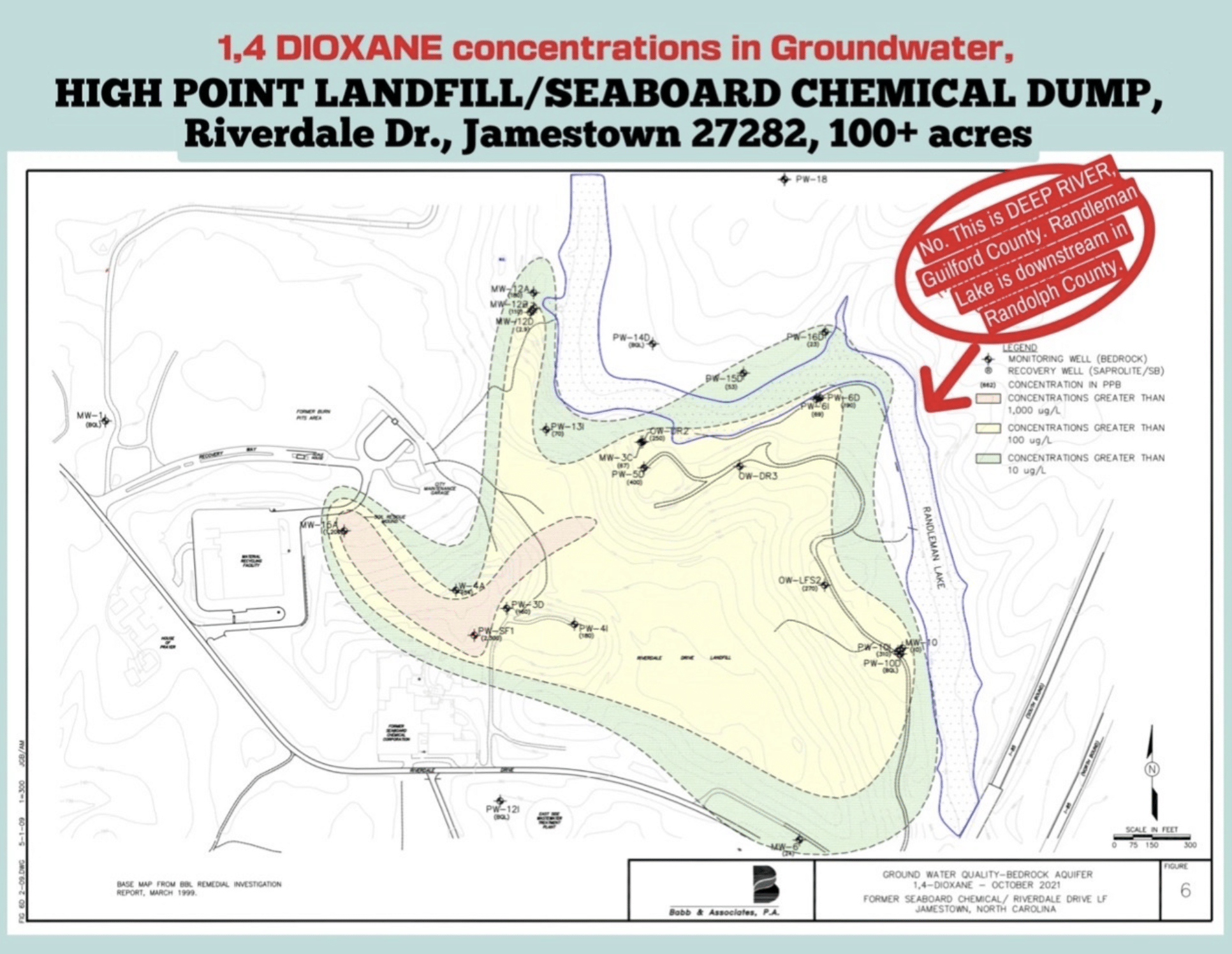
Most concerning to the many residents and professionals who submitted public comments was the fact that Seaboard Chemical dump, once North Carolina’s largest processor of hazardous waste, AND Eastside Wastewater Treatment Plant sat on the banks of Deep River less than 5 miles upstream from the proposed reservoir.
In the 1997 summary memo (below), an employee at the North Carolina Division of Water Quality said modeling done by two engineering firms indicated that “water quality concerns in the future system would be phosphorous-driven, predominantly from the Eastside Wastewater/Sewer Treatment Plant,” which was seeking a capacity expansion.
The memo writer shared the concerns of other NCDEQ staffers who said there was too much potential for “eutrophication” which, the EPA says, causes algae blooms and bacteria toxic to humans, animals and aquatic ecosystems.


The memo writer stated that in October 1997 the NC Division of Water Quality (DWQ) agreed to issue a permit for the expansion at Eastside WWTP with these CONDITIONS:
(1) PTRWA would develop a Randleman Lake Watershed management plan,
(2) PTRWA would USE this plan to establish and manage the high levels of phosphorus and nitrogen that would occur as a result of PTRWA and High Point’s “inter-related” Randleman Reservoir project, and
(3) the City of High Point and ALL local governments with planning jurisdiction in the Randleman Watershed “WILL” be required to address and develop measures to reduce high levels of phosphorus and nitrogen levels from existing and future land use changes.
Further, the memo writer tasked the City of High Point with responsibility for reducing the discharge levels of phosphorus from the Eastside Wastewater Treatment Plant “since that is where 81% of the phosphorus is coming from.” The limits were set at a monthly average of 0.5 mg/L for phosphorus and 6.0 mg/L for nitrogen.
A second memo (from a different NC DWQ staffer) stated that because Eastside’s expansion is “connected directly to the Randleman Lake project,” the Eastside expansion should address secondary issues about the future watershed. The writer then presumes that the City of High Point “will redouble their efforts to provide better watershed protection, wastewater treatment and water quality preventive measures as they will have vested health and safety interests.”
The actions taken by the cities of High Point and Greensboro since then have only worsened the state of Deep River and the Randleman Watershed.
This has been done through lax permitting and monitoring of water discharge, water quality and air emissions, and by disregarding the impact of contaminants (metals, chemicals, volatile organic compounds, PFAS, 1,4-dioxane, toxic bacteria) on the health of local and downstream residents. Here’s how:
1) Chaotic zoning and map play.
The City of High Point physically addressed its Eastside Wastewater Treatment Plant in the Jamestown 27282 zip code, outside of the municipal boundaries of both High Point and the Town of Jamestown (go HERE for an explanation of the difference between 15-square-mile Jamestown 27282 and 4-square-mile Town of Jamestown – it’s a big part of this story), then look at these TWO slides carefully:


The City of High Point has also done this with the Seaboard Chemical dump/old High Point Landfill, GFL construction & demolition landfill, and High Point Materials Recovery/Reclamation Center.
Kersey Valley Landfill (owned by and addressed in High Point), sits beside the GFL C&D Landfill (which is privately owned, sometimes called the “WI High Point Landfill,” and addressed in Jamestown).
Both of the landfills are under the City of High Point’s authority, are closer to Jamestown than High Point, and discharge/run off to Richland Creek/Deep River/Randleman Lake (not High Point’s water supply).

2) Call a river a “lake”
Not sure why they keep referring to Deep River as “Randleman Lake” in Seaboard‘s quarterly and annual groundwater assessment reports, unless it’s to relieve the State of North Carolina from enforcing the drinking water supply “protections” and pollution load limits.
3) Send it to another town.
The City of High Point sends the wastewater from its 21 biggest industrial polluters to Eastside, which outfalls to Deep River in Jamestown, and sends the industrial wastewater from just 4 industrial polluters to its Westside wastewater treatment plant, which outfalls to the Yadkin River Basin.
These polluters – called “significant industrial users” or “SIUs” – are defined as companies and landfills that discharge more than 25,000 gallons per day of industrial wastewater. In addition to those listed in the slideshow below, there are dozens if not hundreds more businesses, factories, golf courses, wastewater treatment facilities, manufacturers, development projects, brownfield sites, inactive hazardous sites, landfills and dumps that are discharging, leaching and draining stormwater to the tributaries of Deep River and Randleman Lake every day.
Scroll through the images below to see the fine print:


4) Permits don’t mean much.
Eastside WWTP’s NPDES permit has been expired since December, 2018 due to its deteriorating state and its numerous and ongoing water and air emissions violations.
The Town of Jamestown’s financial budgets allocate millions of taxpayer dollars to “expansions” at High Point Eastside WWTP and PTRWA (Randleman Reservoir). Yet, the Town of Jamestown‘s population has been on a downward decline since 2019:

Here’s another example of how that zoning and map play works:
This two-page resolution was passed by the High Point City Council last May – it DOUBLES the size of GFL Construction and Demolition landfill (located IN JAMESTOWN) from 315 tons per day to 700 tons per day, upping its annual total intake to 218,400 tons.
GFL, a Canadian company, is leaching 1,4 Dioxane to Deep River, we recently learned.
Several months prior to being gifted with this major expansion by the High Point City Council, GFL’s request was denied by the engineers and experts in the NC Solid Waste section.
But the High Point City Council “fixed it” with two little pages. That’s all it took. With no Public Notice to the residents of Jamestown, where the landfill is located:


5) Where’s that Trust Fund?
In 2008, the State of North Carolina assigned accountability for cleanup of the Seaboard/High Point Landfill site to a list of “Responsible Parties” that includes the City of High Point, Seaboard Group II, Akzo Nobel Coatings, American Woodmark Corp., Ashland Inc., BASF Corporation, Brenntag North America, Carolina Solvents, Clariant Corporation, ConocoPhillips Company, ExxonMobile Corporation, General Electric, Huntsman Corporation, NEPTCO Inc., PermaFix, Cookson Electronics, Marsh Furniture, Rexam Inc., Rockwell Automation, Teva Pharmaceuticals USA, Environmental Enterprises, Valspar Corporation, Thomasville Furniture Industries and Walt Disney World.
A second group of “de minimus” companies that disposed of hazardous materials at the site paid into a Seaboard Chemical Corp./Riverdale Drive Landfill De Minimis Settlement Trust Fund, funds of which were to be used for past and future cleanup.
As time marches on, the Seaboard Settlement Agreement, Trust Fund and Responsible Parties seem to be fading away. In Seaboard’s 2023 Annual Report, the writer gave new meaning to the Settlement Agreement’s definition of groundwater containment by suggesting it was “COMPLETED” with the removal of the above-ground structures from the site when Seaboard was shut down for good in the early 1990s.
6) Don’t pay any attention to those pesky numbers.
On June 27, 2024, two weeks after Eastside’s 4-year Air Emissions permit was signed, an NCDEQ staffer wrote a letter to the its air emissions technician notifying him that Eastside under-reported some of its hazardous and toxic pollutants due to an “error” that decreased the numbers by a factor of 2,000.

After the corrections were made, the toxic/hazardous pollutant numbers reported by Eastside also had to be corrected – to reflect the actual year-over-year increases in pollutant emissions.
Check out these numbers: Arsenic released into the air in 2023 increased over the prior year by 893%; Napthalene increased by 95,842%; Benzene increased by 45%; Chromium increased by 3,113%; Manganese increased by 4,494%; Mercury increased by 5,140%; and Nickel increased by 6,312%; Chloroform increased by 163,459%; DEPH increased by 163,800%; 1,4-Dichlorobenzene by 163,730%; Formaldehyde by 533%; Hydrochloric Acid by 64,416%; Selenium by 4,078%; Sulfuric Acid by 163,639%; Toluene by 356%; Polycyclic Organic Matter by 95,764%.
The corrected report is below – except the new calculations had so many digits they wouldn’t fit in the blocks on the output report!

One of our Jamestown residents did the math and transferred the numbers to an excel spreadsheet so we can see the numbers in their entirety (“CY” stands for “calendar year”):

Here’s another example of reporting errors. This one speaks for itself:

7) The fine is cheaper than the fix.
Despite PHOSPHORUS and NITROGEN reduction and management being TWO of the FOUR REQUIRED CONDITIONS for the 1997 expansion, Eastside has been unable to do this for 30 years and has racked up thousands of dollars in fines and civil penalties – but not enough thousands to inspire the City of High Point to fix it, or to put limits on the dischargers. These are just a few of the most recent:
March 2025 Civil Penalty Assessment, LV-2025-0077. For month of October 2024, weekly phosphorus limit was exceeded by 118.1%; daily phosphorus limit was exceeded by 13.9%. Fine: $2,946.19
Feb 2025 Violation, Case Number NOV-2025-LV-0335. For month of February 2025, nitrogen limit exceeded. For week 2/8/2025 nitrogen limit was 6.0, actual was 9.38; for week 2/22/2025 nitrogen limit was 6.0, actual was 6.95; for month 2/28/2025 limit was 2.0, actual was 8.67
May 2024 NOV-2024-LV-0661, Civil Penalty assessed, phosphorus 92% over limit, fined $4,639
Dec 2023 LV-2024-0121, Civil Penalty assessed, phosphorus 13% over limit, fined $1,830
June 2024 NOV-2024-LV-0748, phosphorus 222% over the limit
August 2023, Violation, NOV-2023-LV-0734, phosphorus limit 0.5; actual was 0.88
July 2023, LV-2023-0338, Civil Penalty assessed, phosphorus 45% over limit, fined $1,478.88
May 2023 Violation, NOV-2023-LV-0497, phosphorus limit 0.5; actual was 0.69
In May, 2023, May 17, 2023
8) Flood the flow meter.
There are two stories here – click on the images for the links:


9) 1,4-Dioxane is 2 B 4-gotten.
On May 17, 2023, the City of High Point received report of a 1,4 Dioxane 681ppb test result, from a sample taken May 12 2023, at Eastside WWTP. A Division of Water Resources split grab sample was later confirmed to measure 1,000 ug/L (ppb), and a composite sample result was 8.4 ug/L (ppb).
This is from a presentation given by the Winston Salem Regional Office of the NC Division of Water Resources to the NC Environmental Management Commission:


The top slide says, “After receiving result, City of High Point staff notified DWR and PTRWA (Piedmont Triad Regional Water Authority) who then notified its members (cities of Greensboro, High Point, Jamestown, Archdale, Randleman). The City of High Point contacted suspected industry INNOSPEC; asked them to analyze retained composite samples for the week of May 8. INNOSPEC stated they did not make the product in question that week but agreed to send samples for analysis. INNOSPEC later notified City of High Point that they had issues with their composite sampler that week, plus a personnel issue so did not collect samples for May 8 and only had a 48-hour composite sample for May 12 instead of the typical 24-hour composite.”
The Division of Water Resources decided to drop it, stating in their presentation: “Those sample results were inconclusive and did not directly implicate them (INNOSPEC).”
So INNOSPEC did it again. In February 2025, the City of High Point released its 2024 Annual Pretreatment Report which includes a round of 1,4-Dioxane wastewater test results for some of its SIUs in High Point. INNOSPEC’s 1,4-Dioxane level – from a single test in the second half of 2024 – was 1,370 PPB.
But then THAT result was topped by a whopper of a 1,4-Dioxane reading of 546,000 ppb for CINTAS Corporation.
These High Point numbers far exceed an 813 ppb number recorded at the Asheboro Wastewater Treatment Plant in December 2024, but that 813 ppb Asheboro number is now the basis for a lawsuit filed by the Southern Environmental Law Center.
Not a single local authority, government or utility has issued a statement or expressed a single concern, explanation or public alert about these upstream dischargers’ high 1,4-Dioxane numbers.
The state and federal limit for 1,4 Dioxane in water supply sources, by the way, is 0.35 ppb.
10) Decimal dislocation.
This is from High Point water customers’ latest Consumer Confidence Report. It doesn’t do much for Consumer Confidence:

For comparison, below are PFAS test results from High Point water customers who paid to have their tap water tested:

The aggregate number matters, because PFAS travel in groups and it’s the aggregate number (and hazard index) that tells us how bad it is. Note that the citizen’s High Point sample result on the right was drawn in November 2024, same month as those in High Point’s Consumer Confidence Report.
11) When it’s bad, just stop testing.
In 2022, PFPrA was found in High Point City Lake at levels ranging from 2.23 PPT to 17.1 PPT. High Point responded by stopping its PFAS testing and/or public reporting for High Point City Lake and Oak Hollow Lake:

We KNOW the levels of PFAS in our streams, lakes and drinking water are rising because we’ve tested for it, and others have tested for it.
The levels are increasing, not decreasing.
NC Division of Water Quality records and reports from the late 1990s are filled with objections and opposition to the Piedmont Triad Regional Water Authority’s (PTRWA) desire to create a “future” drinking water supply source called Randleman Reservoir.
PTRWA’s proposal involved damming Deep River a short distance downstream from, and on top of, known hazardous sites, landfills and chemical dumps. The plans called for Randleman Reservoir and its water treatment plant to be located in Randolph County, but most of its customers would be serviced in Guilford County.
PTRWA eventually got the permits it needed to impound Deep River with a dam in Randolph County, about 10 miles downstream from Jamestown. In 2010 PTRWA began piping finished water to Greensboro, Jamestown and High Point customers.
The “future” is here, and so are the water quality problems predicted by the NC Division of Water Quality (DWQ). Randleman Lake has a big PFAS and 1,4-Dioxane problem, Eastside WWTP is falling apart, and the state of North Carolina isn’t rushing in to fix it.