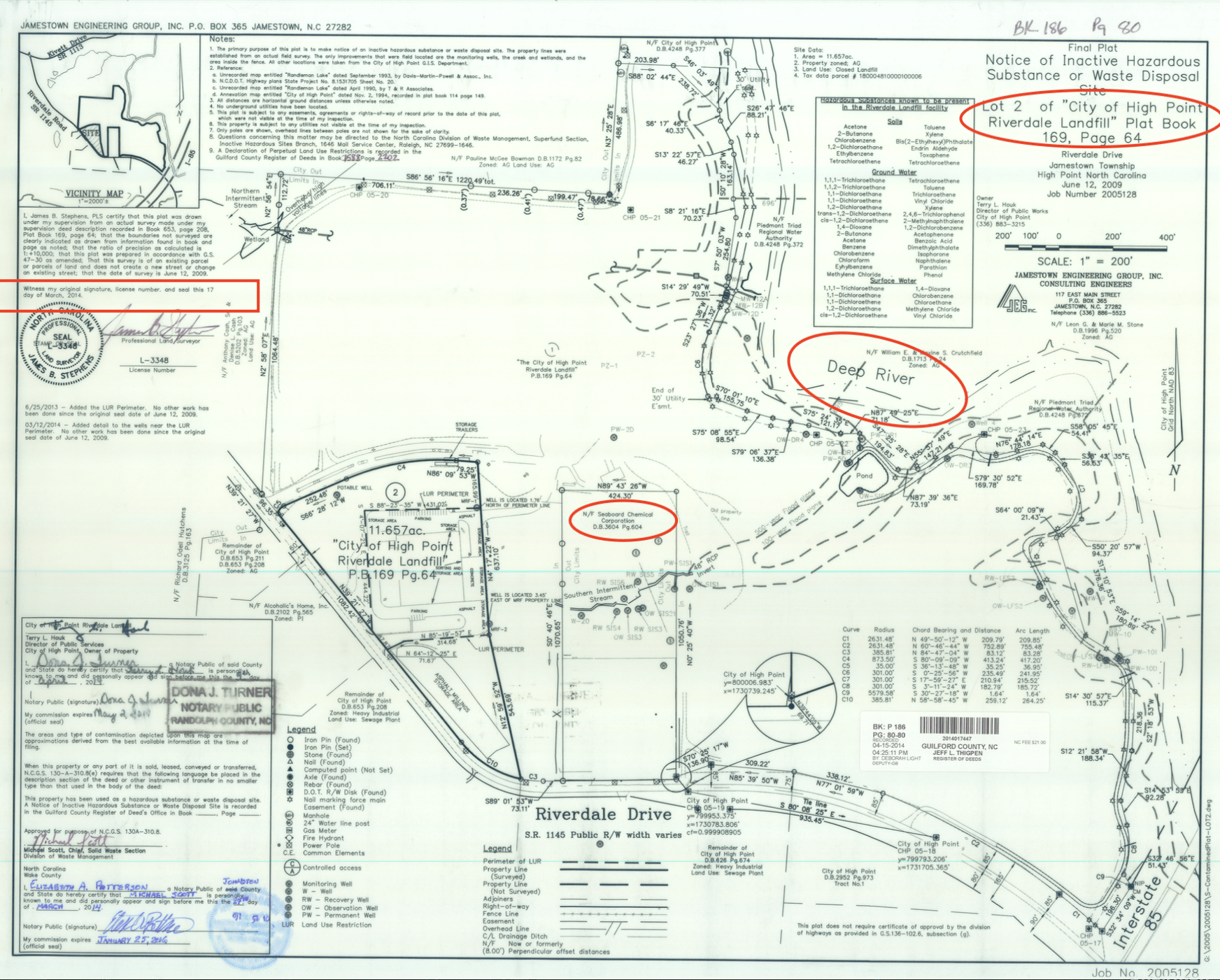
[New files and public records have been added and indexed to the SEABOARD/HIGH POINT LANDFILL dropbox, here.]
In May of 2016, a local reporter by the name of Taft Wireback wrote a piece for the Greensboro News and Record titled “Seaboard Chemical Still Awaits Cleanup,” about the severely contaminated, 163-acre Seaboard/High Point Landfill site on Deep River in Jamestown 27282.
The story focused on the owner’s (City of High Point) 27-year-long failure to clean up a lengthy list of hazardous chemicals and volatile compounds left behind in the soil and groundwater. Wireback ended his story with a call for a “greater sense of urgency from High Point’s leaders.”
Read Taft Wireback’s 2016 report:


It’s nine years later. The groundwater cleanup hasn’t happened. A decade of “progress” reports, test data, and compliance inspections are watered down with excuses, extensions and disappearing monitoring wells.
High levels of 1,4-Dioxane, vinyl chloride, PFAS, benzene, PCE and various volatile organic compounds continue to leach, drain and run into Deep River and Randleman Reservoir drinking water supplies.
In Wireback’s 2016 article, a City of High Point spokesman for the cleanup suggests that state regulations are partly to blame for the slow “progress” at the site.
I have also discovered the fact that the Division of Water Quality or DENR [NCDEQ] has never pulled or attempted to pull samples of the Deep River sedimentation around the Old High Point Landfill area which is also where the stormwater that Seaboard Chemical illegally discharged would have ran into Deep River. I indicated that not only were heavy organics being discharged, but halogenated solvents also.
George Willard, former acting plant manager, Seaboard Chemical, Jamestown, NC, September 2001
Wireback notes the headline-making noncompliance issues Seaboard dealt with throughout the 1980s and Seaboard’s “slipshod” operating style that “sparked outcries from residents of the area who urged local officials to pull Seaboard’s plug” in order to protect them [the local residents] from pollution of their air, water and soil.
Some of those outcries just popped up in a new batch of public records. They were written years ago by former Seaboard employees, one of whom was a plant manager. This first letter, dated September 8, 2001, is from a former Seaboard plant manager to the U.S. Environmental Protection Agency Region 4 office in Atlanta:

On August 7, 2001, Mr. Willard forwarded two letters from Leon Owen, a former worker, to Bob Glaser with the NC Hazardous Waste Division. Since it is difficult to read some of his typewriter ink, I transcribed Mr. Owen’s letter below:
Dear Sir:

I am an ex-employee who worked for chemical manufacturing companies, both in High Point and Greensboro. I know what deadly toxic material is in the landfills. We buried hundreds of thousand of gallons of asbestos and white lead and red lead paints. Benzene, Xylol, Toluol, Phenolmercuryoleate, all type of acids and caustic sludge went into drums and was covered up to rust out and drain into Deep River for hundreds of years to come.
The company lost 14 people in two years from lung and liver cancer. I can name every one of these people. Since 1968, the year my boss man died, and the long stay in Moses Cone hospital for me and my lung suffering from exposure of this toxic environment.
The total number of deaths of those who worked with me to this date is twenty-eight (28). We all mixed and breathed these products. I cannot say that I’m the lucky one because l’m still living. I am seventy-one years of age. Have been on a Bird breathing machine and oxygen since 1938. Have suffered all this time from the exposure.
If this thing of the Randleman dam comes to pass and people have to drink the water, you or someone is to be responsible for the death of many people. I know what is in the river bottom. It has to be hundreds of feet deep in the river bed and in the soil for hundreds of feet each side of the banks.
If you don’t believe me, check with some of the people we sold just one item of this material to. One company was located in Warner Robins, Ga. Recently they have found toxic chemicals 30 feet deep under their water supply and the paper, Warner Robins News, said the water is too toxic for human consumption.
I live near the [Deep] river and for the last three weeks the water is black and smells like mineral spirits. I have noticed there are not many animals along the river and what comes near will never drink. This should tell these not-so-wise people something.
My land is for sale. I am willing for them to have it right now. But, I think the good lord would want me to tell and warn others about what we have done to our streams. We do not drink our well water without distilling first. It has the taste and smell of thinner where paint brushes are washed. Our well is some 250 feet from the [Deep] river.
Leon D. Owen
And this is Mr. Leon Owen’s 1990 powerful three-pager included in the Army Corps of Engineers’ Randleman Dam Environmental Assessment document:


More “outcries” from local residents are catalogued in this December 2000 Environmental Impact Statement prepared by the Army Corps of Engineers, who – like the NCDEQ – advised AGAINST the use of Randleman Lake as a drinking water source.

Even the North Carolina Department of Environmental Quality thought making Deep River a drinking water source was a bad idea:

It came as no surprise to read in George Willard’s letter: “I have been talking with some other folks at [the NCDEQ Division of Water Resources] about the Deep River. The person I had talked to told me that the Division of Hazardous Waste and Division of Water Quality [Water Resources] were made to sign off on the Randleman Dam project, whether they felt comfortable with it or not. The Greensboro politics were going to push them to approve this.”
Cancer, noxious fumes, Seaboard’s “special” permit that ignores watershed regulations:


In 2006, Randleman Dam was completed 11 miles downstream from Jamestown, and the Piedmont Triad Regional Water Authority (PTRWA), which treats, sells and pipes the Deep River/Randleman Lake water back to us, began filling its reservoir with Deep River water. In 2010, PTRWA began piping its water upstream to its new paying customers – residents of Guilford County (Greensboro, High Point, Jamestown, Archdale, Trinity). In 2020, the NC Dept of Environmental Quality (NCDEQ) and NC State Assembly created and codified the Randleman Water Supply Watershed Rules to strengthen protections for this vitally important drinking water network that not only serves as the industrial waste stream for furniture, textile, auto, bus, metal plating, chemical, plastics, packaging, printing, asphalt, paint, lacquer and pharmaceutical manufacturing; but also gets leachate and runoff from hundreds of acres of landfills, the Colonial Pipeline/Plantation Pipeline tank farm, “Inactive Hazardous Sites,” Brownfield sites, and failed Superfund sites – like Seaboard.