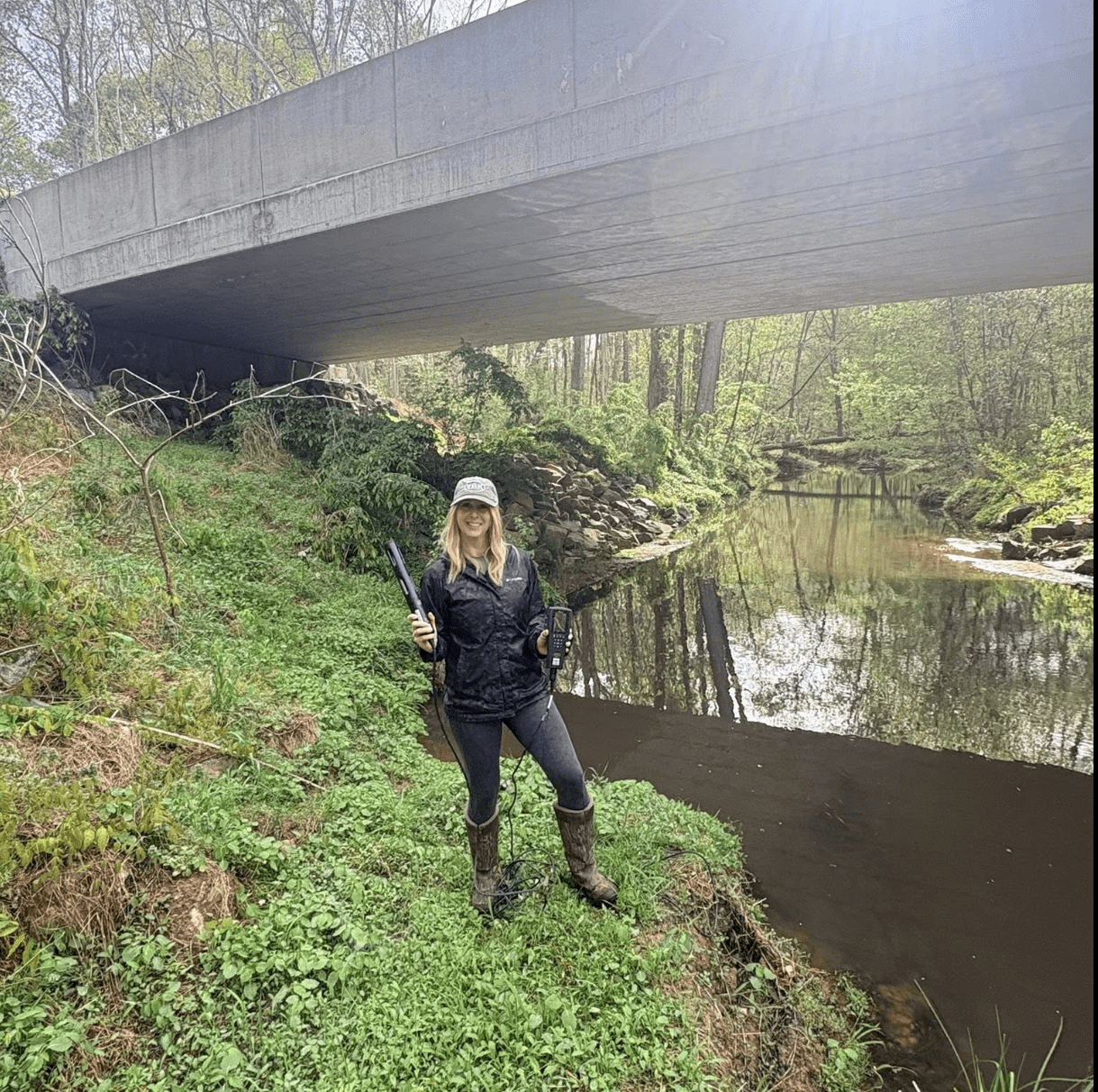
From Dec. 2024 through Dec. 2025, hundreds of water samples drawn from Deep River, Bull Run and Richland Creek were tested by the nonprofit organization Deep River Riverkeeper (“DRRK”), aided by Duke University Superfund Center and volunteers from Guilford and Randolph counties.
Riverkeeper Stephanie Stephens has been collecting and compiling the results, just released as the “2025 River Report,” with a focus on PFAS and E. coli contamination.
The full 26-page report can be found HERE, but I’ve pulled some items that may be of particular interest to residents of Jamestown. [Photos, graphics and stats credits go to Stephanie.]
BULL RUN
Bull Run, water supply source and feeder to Deep River/Randleman Reservoir, flows north to south through Jamestown. Stephanie places its origination point in “a retention pond at a Greensboro shopping center near Sapp Road and Wendover West,” from where it flows 6.67 miles before emptying into Deep River below Oakdale Mill near the Harvey Road Bridge in Jamestown.
A December 2024 sample drawn from Bull Run near Guilford College Road (“Site 1 BR”) became a site of concern during DRRK’s sampling initiative with Duke Superfund Laboratory. The tests showed total PFAS of 179.655 parts per trillion (ppt) and high levels of Aqueous Film-Forming Foam (AFFF), used to fight fires. AFFF is a major source of PFOA and PFOS compounds that are persistent, bioaccumulative, and toxic.*
“Site 2 BR” is located at the Bull Run headwaters, and “Site 5 BR” is near Bull Run’s confluence with Deep River:

*[The EPA’s enforceable Maximum Contaminant Levels for five specific PFAS are 4 ppt for PFOA and PFOS; and 10 ppt for PFHxS, GenX and PFNA. PFAS is the group term for hundreds of different “forever chemical” compounds, so called because they bioaccumulate in your body and never leave. Reverse osmosis is the most effective filtration system for removing forever chemicals from water.]
In May and November of 2025, DRRK sampled five sites on Bull Run using Cyclopure** test kits, which are highly effective but track fewer compounds than Duke and facilities like EcoLab.
The May 2025 results at “Site 1 BR” were 14.2 ppt, but rose to 90ppt in November:

Stephanie says the results suggest a nearby source is being used at certain times of the year and entering Bull Run as runoff, noting the proximity of the Guilford Technical Community College Firefighting Training Center adjacent to the sampling location.
**Duke Superfund utilizes high resolution mass spectrometry and non-targeted analysis to detect over 1,000 different PFAS compounds. By comparison, Cyclopure Kits measure 55 of the most prevalent PFAS compounds. Both methods are effective, Stephanie says, but Cyclopure doesn’t have the capacity to test for AFFF. However, high levels of PFHxS suggest AFFF is present and persists in Bull Run stream at this Jamestown location.
DEEP RIVER
The report speaks to Deep River’s history as an industrial stream, and points out that Deep River continues to receive wastewater and stormwater runoff from many industrial source points throughout Guilford and Randolph counties.
An active EPA Superfund site, Seaboard Chemical, and two landfills (Kersey Valley and GFL Construction & Demolition landfills) are located along Riverdale Drive in Jamestown/High Point, upstream of Randleman Reservoir.
“The Randleman reservoir sits on top of an old unlined Randolph County landfill,” Stephens reports. “As of 2025 our research through EPA’s Echo site shows upwards of 711 industrial factors/plants with NPDES permits, some of which have been flagged for PFAS and 1,4-Dioxane, and/or operate with expired or unlimited permits, like Eastside Wastewater Treatment Plant.
“Trash pollution is another issue on the Deep River and its tributaries, predominantly in Guilford County … DRRK has signed a contract with PTRWA to conduct a large scale cleanup of the confluence of Richland Creek at Deep River.”

The December 2024 DRRK/Duke Superfund Lab tests included samples drawn from Deep River in Guilford, Randolph and Lee Counties. Five more samples were tested using Cyclopure kits. The Oakdale Mill sample was drawn above (north of) of the Oakdale Mill Dam:

RICHLAND CREEK
Richland Creek flows 8.1 miles east from Ward Avenue and Green Street in southwest High Point to its connection with Deep River in Jamestown 27282.
In April 2025, one of five sites sampled by DRRK on Richland Creek (Cyclopure kits) showed total PFAS at 419.5 ppt:


E. COLI
Patterns of high E.coli levels in Deep River and its tributaries reveal a persistent contamination issue after heavy rainfall. Following a rain event lasting a full day or more, E. Coli levels measured well above the 235 cfu/100mL limit.
During tropical storm Chantal (July 2025) Deep River reached the Action Flood Alert level in Randolph County and breached the Moderate Flood Alert level in Moore, Chatham and Lee counties.
On July 11, 2025, the following flooded sites were tested for E. coli; all had levels over 1,200 cpu/100mL:
-Unnamed creek at Rotary Drive and Ray Avenue (High Point)
-Deep River at Wade Avenue (Jamestown)
-Bull Run at Deep River (Jamestown)
-Deep River Access Site (Chatham County)
-15/501 Access Site (Lee County)
NEXT
Looking ahead, Stephens said DRRK will continue sampling for PFAS and E. coli but expand its test parameters to include nitrogen, phosphorus, orthophosphate, chlorophyll-a, and more. “We will conduct studies on fecal coliform at sites we know have elevated E. coli presence in order to trace the pollution to the sources.
“Additionally, we have embarked on a unique study with UNC-Greensboro to study biodiversity in three locations along the Deep River. We have installed aquatic and terrestrial microphones to collect bioacoustic data, which scientists will later analyze to understand the place of non-human species in the river and on its floodplain.
“The monitoring devices have been strategically placed near dams that are being removed to help determine the success of species regeneration once the river is restored to its natural state.
“Stay tuned for more information on the DRRK website and social media as this project continues.”