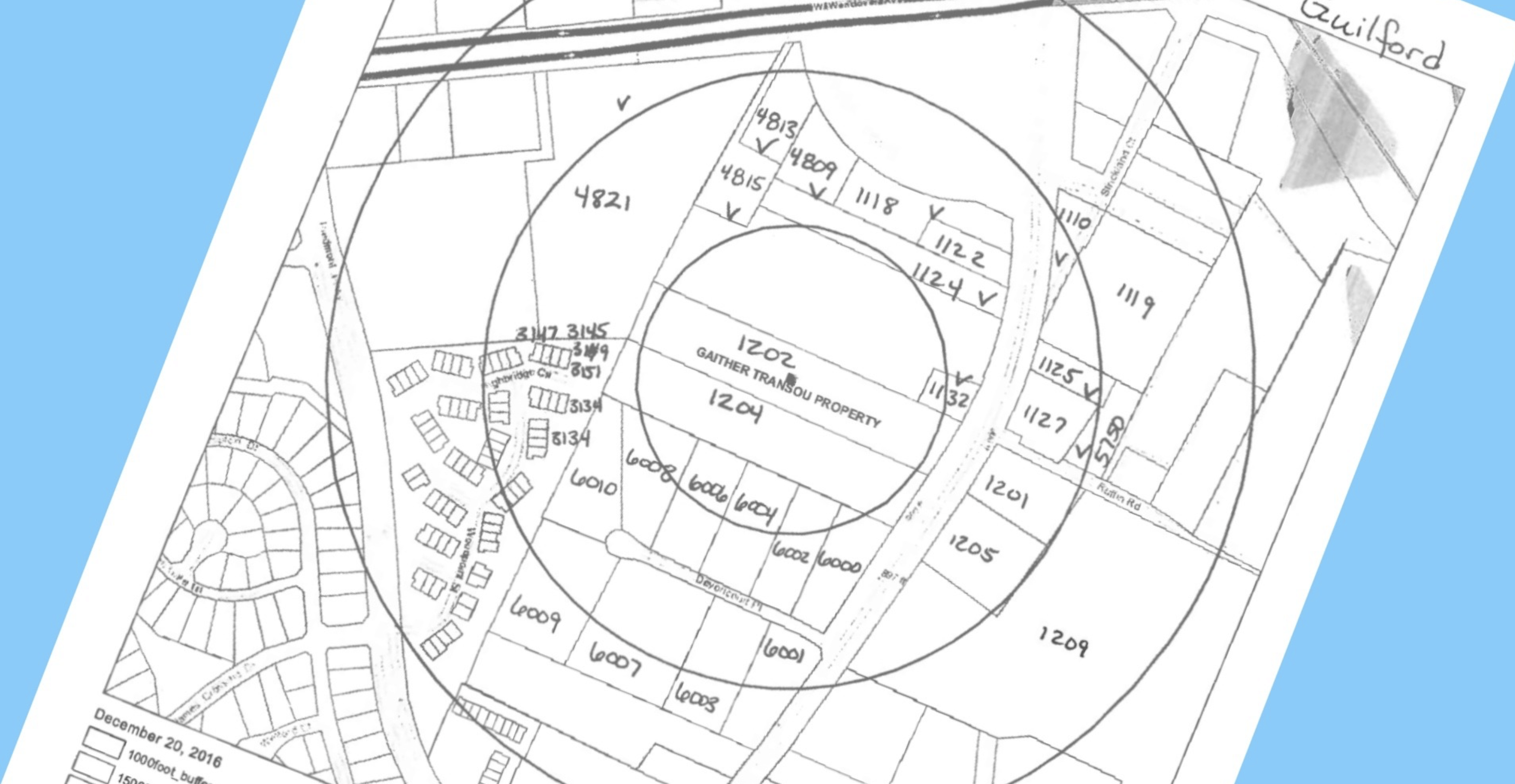
FEBRUARY 8, 2026: Violations for illegal burning, land clearing and failure to conduct a required environmental assessment have resulted in a termination of the owner’s Brownfield application for redevelopment of the property at 1202 Guilford College Road in Jamestown. Correspondence from the North Carolina Department of Environmental Quality is below (click to enlarge image):


[Link to more files, NCDEQ public records for “TRANSOU, RedRock, GC ROAD” are here. PART 1 in this series (about the properties at Wendover Avenue and Guilford College Road) is HERE. PART 3 is HERE.]
APRIL 22, 2025: In February and March of 2024, a series of groundwater, soil and soil-gas/vapor tests were conducted on the Transou property at 1202 Guilford College Road, one of two potential development sites at Guilford College & Wendover Avenue. Both sites are Brownfields, both are on the NC List of Inactive Hazardous Sites, and both are being assessed for development as apartment and multifamily-unit communities.
ATC Environmental’s “Groundwater and Soil-Gas Investigation Report” (public record link below) for the 1202 Guilford College Rd property was submitted to the NC DEQ on May 30, 2024:
A sample taken from a water well on the site on Jan 18, 2017, was tested for 1,4 Dioxane. The EPA health advisory for, and North Carolina’s target value for, 1,4-Dioxane in drinking water supplies is 0.35 ug/L. The lab’s PQL (Practical Quantitation Level) is 3.0 ug/L – which means this particular test lab can’t reliably detect levels of 1,4 Dioxane below 3.0 ug/L.

Water samples from private wells located at or near the Transou property (1202 Guilford College Road) were tested for VOCs, metals and PFAS by the NC Dept. of Environmental Quality in 1992, 1994, 1995, 2023 and 2024.
In 1997, the homes in the test group were connected to the City of High Point public water system. Correspondence in the public records indicates that even though the residents in this group no longer use their well water for drinking or cooking (since they were connected to the High Point system), the wells remain functional, so they were used to draw groundwater samples for analysis in 2023 and 2024.
In a January 26 1994 memo to the file, Robert Gandley, an Engineer in the NC Superfund Section, said it is “most likely” that the groundwater from the Transou property flows to the southwest.
The memo also states that prior to 1994, wells that had been tested within 1/3 mile north of the property showed “low levels of 1,2 dichloroethane, 1,1-dichloroethane and tetrachloroethylene.” That memo, along with details about the High Point water hookup, is in the file link here:
Results of groundwater and soil samples in the immediate area are below, starting with June 2024 (1 ng/L = 1 ppt, and 1 ug/L = 1 ppb):


Read Part 3, “Chloromethane found in multiple locations…” HERE.